

How an upstart effort is transforming hunger in Elkhart County and bringing the community along with them.
For decades, dozens of food pantries in Elkhart County offered help to hungry people. For the last year, they’ve done it together.
In early 2025, three men gathered for breakfast to talk about how to help fight hunger in Elkhart County. Andy Murray, chief strategic initiatives officer for the Community Foundation, sat with “Irish” Dave O’Connor, who works in nonprofit communications, and Jim Conklin, who co-founded Cultivate Food Rescue.
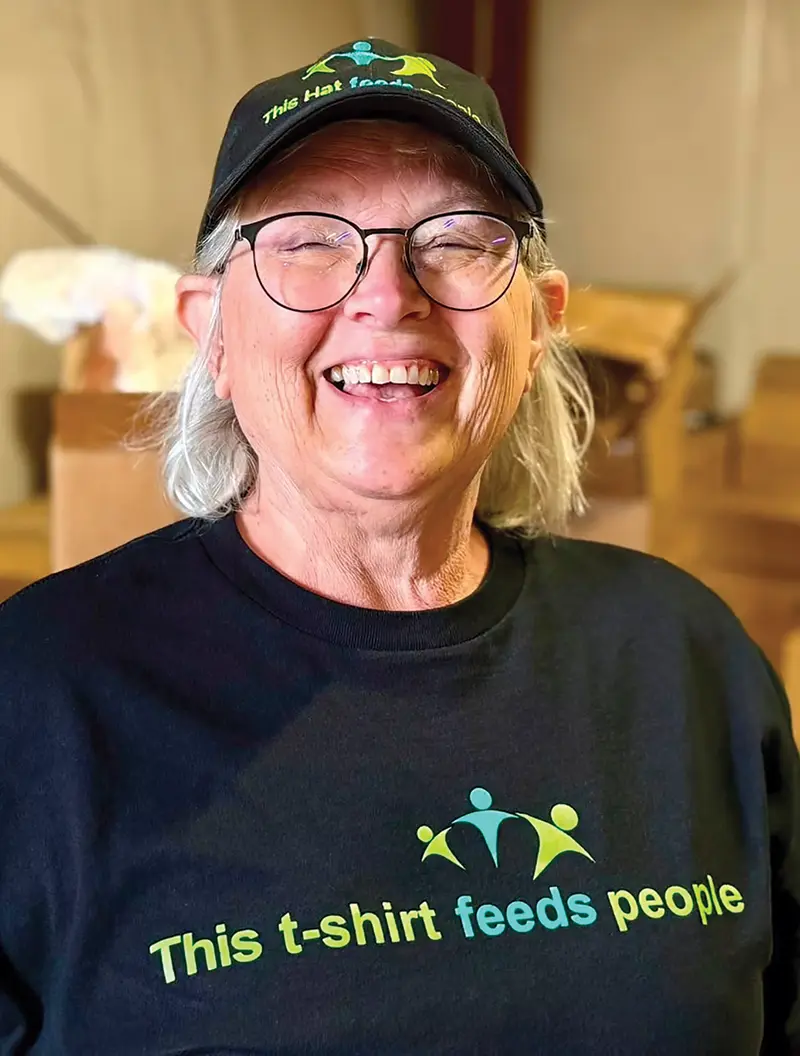
Pam Bingaman of Middlebury Food Bank is one of many partners in Hunger Ends Here.
Murray had realized through his work with Building Strong Brains that economic self-sufficiency was a fourth piece of the puzzle for helping children and families thrive, alongside maternal and child health, community supports, and quality child care/early learning environments. Conklin, whose organization rescues food and repurposes it to fight food insecurity, knew there was no collective effort to maximize coverage and minimize cost.
The men agreed to invite some food pantries to the table and ask what would help them. The response was outreach and awareness. The initiative launched in September 2025 with the name Hunger Ends Here.
Soon, representatives from a dozen organizations were gathering as a formal advisory council to share information about the work of the 50 or so pantries in the county. A new countywide food assistance directory cataloged the agencies offering help.
Then came the first crisis.
Funding for Supplemental Nutrition Assistance Program benefits ended in early November 2025 because of the federal government shutdown, leaving millions of Americans without help buying food. Scott Griffey, a Jimtown resident who had started delivering food to people during the COVID-19 pandemic, was preparing to open Gymtown Food Bank. Hunger Ends Here, and a $120,000 grant from the Kids & Families Committee of the Community Foundation helped it open more quickly. Milford Food Bank helped the Community Foundation buy $200,000 of food, including a semi-load of 30,000 jars of peanut butter at a deep discount. As Elkhart County’s first independent food bank opened, it had more than $500,000 in food to help pantries withstand increased demand due to reduced federal help.
Within a few months, 60 organizations were using the food bank to obtain and distribute free food to those in need, according to Griffey. In summer 2026, more than 9,000 families per month were receiving food from the food bank.
At the Community Foundation’s Annual Celebration in October 2025, President Pete McCown touted the work of Hunger Ends Here and said no child in Elkhart County should be hungry. As the Community Foundation gathers people around the table, it can convene without triggering competition for resources. The resulting collaboration is “the most productive thing the community can do to fight food insecurity,” according to Conklin.
The collaboration is helping Cultivate save, repurpose, and distribute millions of pounds of food. One pantry that didn’t need a donated forklift paved the way for another organization to get it.
The collective is also generating donations. Thor Industries donated two vans to help move food within the county. Sugar Grove Church brought a $10,000 check, which can buy $100,000 worth of food.
Relationships lead to easier conversations and quicker action. When strong storms, including a tornado, hit Elkhart County in early June 2026, Hunger Ends Here improvised a quick response to pack and distribute 500 food boxes within 48 hours. People who had never used a food pantry before received food to replace losses from power outages or other challenges.
The everyday reality is that in Elkhart County, many families don’t get to choose what they eat. They have to choose between buying food or paying for other costs, such as housing or transportation, Murray says. Housing costs consume three times as much of household income as they did two decades ago. “Food insecurity, or not knowing where your next meal is coming from, is largely a housing cost crisis,” he says. “Food pantries are serving people who paid their rent and now can’t afford food.”
Hunger Ends Here is working to reduce the stigma for those who need food by putting it in a broader context, such as increased housing costs. In addition, it highlights that the effort to keep each other fed is community work that brings people together. New billboards tout, “You come for food, you leave with community.”
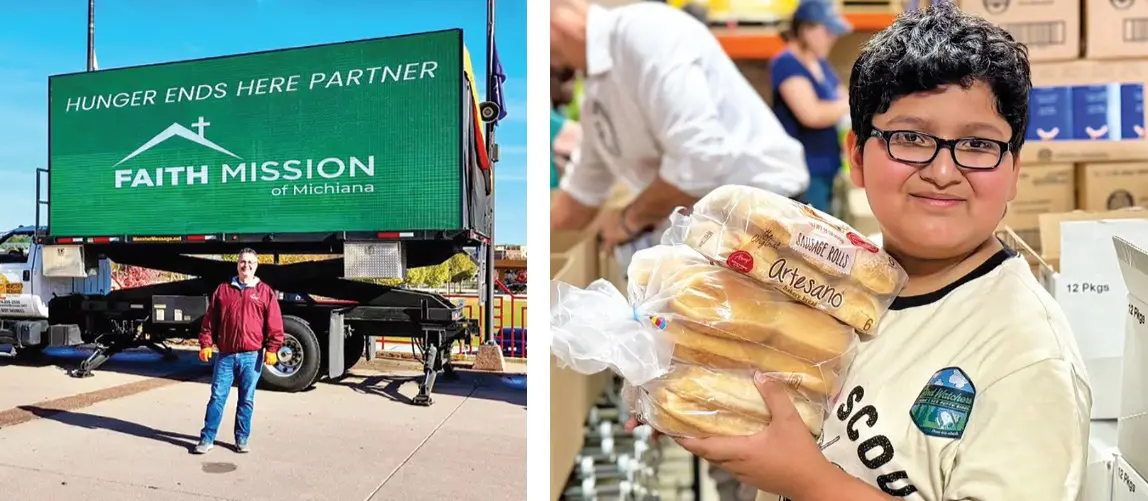
A range of partner agencies and volunteers are collaborating to help Hunger Ends Here reduce hunger in Elkhart County.
Volunteers at Gymtown and other pantries are key to fighting hunger. Ashley Jordan, director of Acts of Service at the Community Foundation, says that finding volunteers in some areas can be difficult, but people often want to give their time to combat hunger, improve mental health, or respond to disasters. “That’s been a trend for a while now, and I think it’s because more people are being affected by it post-COVID,” she says.
Cultivate was supported by more than 12,000 volunteers in St. Joseph and Elkhart counties from April 2025 to April 2026, according to Conklin. When the mission is clear, people respond. “People want to make Elkhart County a better, vibrant place to live and work,” says Jordan.
Matt Sigsbee has been a regular volunteer in the community since his retirement. He didn’t want to sit on the bench and, after encouragement from McCown, he started volunteering not just at Wellfield Botanical Gardens, where he is on the board, but also at the NAIA Swimming and Diving Championships. Even that was a one-time event. He wanted to do more, so Jordan connected him with the Middlebury Food Pantry, where he helps once a week. He enjoys helping meet community needs. “Knowing these people will get their groceries for the week. That’s a good thing,” he says.

STORIES OF
IMPACT

Read our most recent Stories of Impact in our latest annual report (PDF).