
Honoring Sang Brooks’ resilience by opening doors for students to pursue education
Sang Pyong Brooks was a survivor.
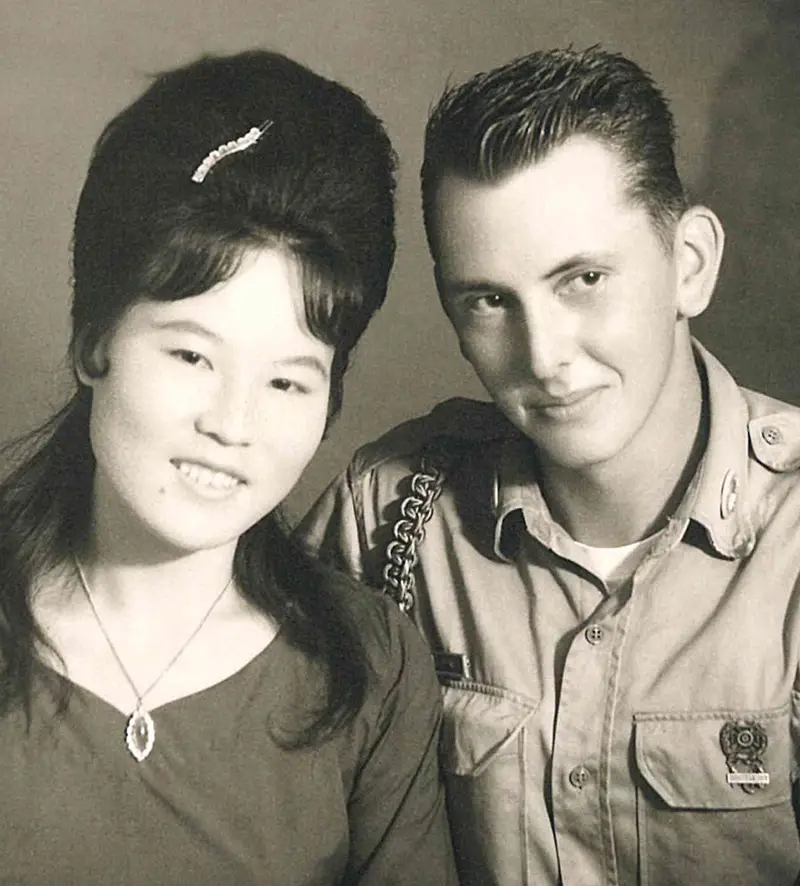
Don and Sang Brooks married in 1965 and settled in Elkhart.
She never talked much about what she saw as a 7-year-old girl in Seokdal, South Korea.
On a December day in 1949, soldiers came to her village of 98 people. Her mother hid her under her kimono as soldiers shot and killed the women and babies in the village. A bayonet barely missed Sang under the dress.
When 46 men and children came back from school in a nearby village, the soldiers killed them too and Sang escaped again as people around her were killed. She was one of 12 survivors in the village. Her father, mother, and brother all died that day.
In the years that followed, she was an indentured domestic servant for relatives and escaped terrible situations twice. She wasn’t allowed to go to school, though she wanted to, and never learned to read and write. As a teenager, she fell in love with a South Korean soldier and they hoped to marry. When his father didn’t approve, they both attempted suicide. They both survived.
In America, Don Brooks was a survivor in a different way.
“We didn’t have anything. Nothing! One fork. One knife. One spoon. One fry pan. One cook pan. I made coffee in the fry pan.”
Sang Pyong Brooks
He had grown up in Buchanan, Michigan but left a dysfunctional family at the age of 16 and picked fruit in California for several years before joining the U.S. Army. He was stationed near Seoul, South Korea, when he met Sang in 1964. After a couple beers, he was dancing with her, and their romance blossomed. They married and returned to the United States.
His family wouldn’t help the young married couple much and their life was difficult. In “Loneliness of a Survivor: Sang’s Village Massacre,” a new book by Larry App, she said, “We didn’t have anything. Nothing! We moved into an apartment house. One fork. One knife. One spoon. One fry pan. One cook pan. I made coffee in the fry pan.”
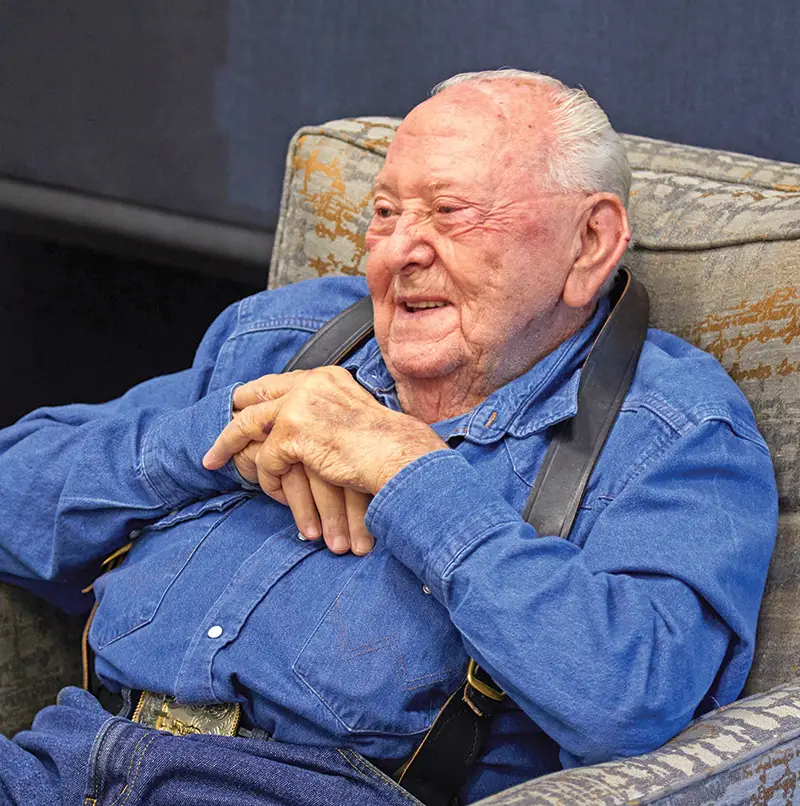
Don Brooks smiles as he recalls a rich life with his late wife, Sang.
Don got a job at Dexter Axle as a truck driver. She did some babysitting and worked to learn English. A neighbor in the apartment house taught her to cook. They soon rented another house and she started doing work for the landlord to reduce their monthly rent. That led to a job at J.J. Babbitt, where she engraved gold insignias on mouthpieces of instruments. Though she couldn’t read or write, she learned the job and did it well. “They trained her and she did it all by memory,” says Don.
Don fixed their cars. Sang did the cooking and cleaning. When he was on the road in various trucking jobs over four decades, she would go to work and work in her garden. She became known for her food, particularly her egg rolls, and her flower arrangements.
Don says he asked her, “‘Why are you always outside, doing flowers and planting gardens?’ and she says it kept her mind off her family. So that’s why she did it. And she would go, I don’t care who it was, even in Florida, she would go into friends’ flower beds, and she’d pull the weeds. But she touched a lot of people’s hearts doing that.”
She didn’t have a family, other than a cousin, in Korea. She had few memories of her family. She worked hard and became a U.S. citizen. “I came to the United States and I want a good life,” she told App for the book. “I want a better life. I don’t want to live like in Korea. Even though I’m from a different country, I’m a good citizen. … I’m proud of what I have. I’m living here in the United States. I’m very proud. So, I’m not ashamed. I work hard for what I have. I earned it. Every penny and every dime. I’m happy in the United States where I am living.”
“I thought what they would enjoy is the way the Community Foundation comes around someone and really guides them to something that’s good for them based on their interests.”
DAN Craig, the Brooks’ Financial Advisor
The couple spent less than they earned, saving what they could. They were early adopters of 401k matches. “Save and invest. Every time we would get a little bit of money, we would invest it,” says Don.
In the early 1990s, they started financial planning with an initial $5,000 investment.
When they made purchases, such as for a home in Florida, they didn’t spend as much as they could have and their savings grew.
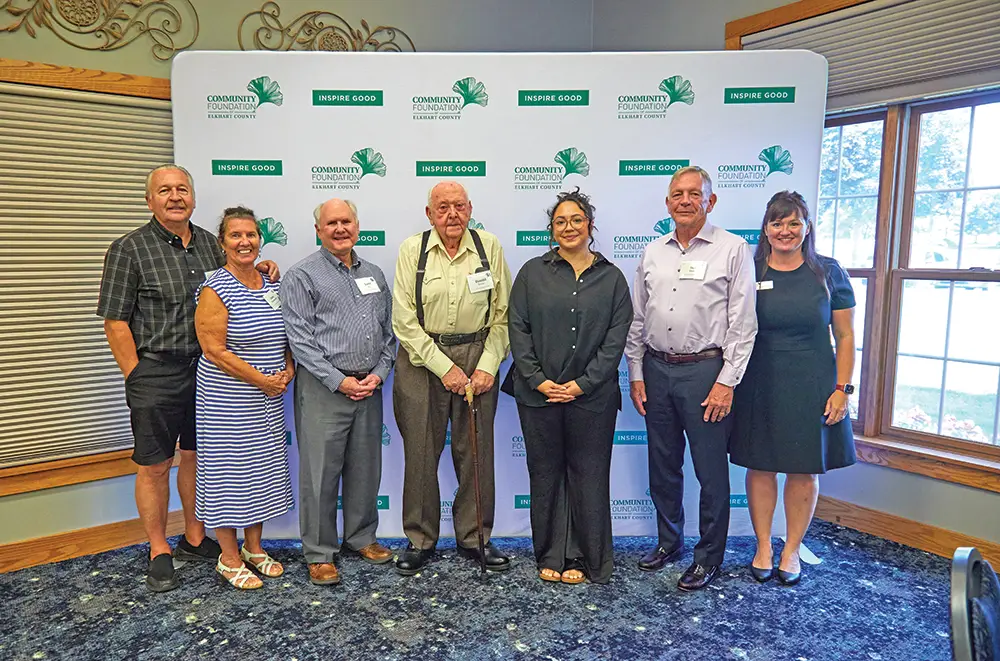
Sofia Valdes Nunez (third from right) is the first recipient of the Don and Sang Brooks Scholarship. She’s shown here standing next to Don in July 2025 and with (from left) Randy Butterbaugh, Kathy Butterbaugh, Larry App, Dan Craig and Carrie Berghoff.
They supported Methodist churches they attended. Dan Craig, their financial advisor, saw an opportunity for charitable giving that would fit their hopes. “They really were attracted to scholarships because neither of them had graduated formally from school,” Craig says. “I thought what they would enjoy is the way the Community Foundation comes around someone and really guides them to something that’s good for them based on their interests. To me it just seemed like a very natural match.”
Don and Sang, with Dan Craig, came to visit the foundation in fall 2024. Sang lit up the room with her vibrancy and told some of her personal story. With Community Foundation staff, they set up a scholarship fund to support students who can’t afford higher education. That was Sang’s wish. Don added, “I believe there’s a lot of kids that are smart. I want them to get a good education.”
In the months after that visit to the foundation, Sang’s health declined as the presence of cancer increased. Don sat at her bedside, holding vigil and urging medical staff and caregivers to minimize her pain. She died in January at the age of 82 after a long, rich life with her husband and many friends. She was a survivor who overcame so much to live a joyful life.
The first Don and Sang Brooks Scholarship was awarded this spring to Sofia Valdes Nunez. Don, still grieving Sang’s death, sat with Sofia at the foundation’s annual Scholarship Brunch in July. Meeting her and hearing her story was a comfort.