

How $2,500 a year gave Eric Firstenberger room to pursue two degrees, take a chance on himself, and return to Elkhart County to teach.
As told to the Community Foundation of Elkhart County
My name is Eric Firstenberger, and I teach algebra to freshmen at Jimtown High School. Most afternoons, I’m on the tennis courts there too, coaching the same kids I had in class that morning. None of it would look quite like this without a scholarship I received from the Community Foundation of Elkhart County back in high school, one that gave me room to become someone I might not have become otherwise.
My dad, Bill, took a job as director of Ruthmere Museum in 2010, and our family moved to Middlebury a year later. I attended Northridge Middle School and Northridge High School, graduating in 2018 as part of a 10-person International Baccalaureate diploma cohort. That program has since been discontinued, and I’m the only one from that group still living in Elkhart County.
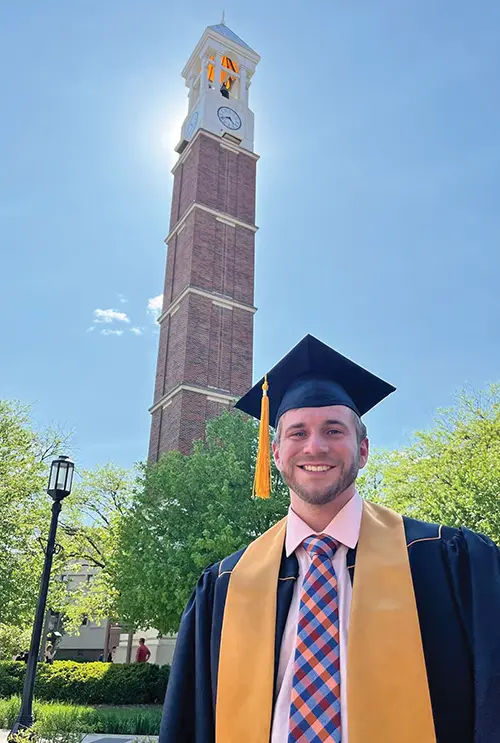
Eric is a 2022 graduate from Purdue University.
I was a good math student, though I’ll say it plainly: I was never going to be a math professor or write a book on theory. I was trainable. Show me a process once, and I could repeat it again and again, through problems that grew more complex. When I applied for the Blakesley Scholarship for Mathematical Excellence, I figured a few classmates were more qualified than I was. I got the call from Samantha Lambert at the Community Foundation while standing on the second floor of Northridge High School, the only spot with cell reception. I’d never taken a call quite like that before, and I was so happy and grateful.
That $2,500 a year made Purdue affordable in a way that changed what I could pursue. Without it, I would have taken on more loans and felt more pressure to finish one degree and get out with a job in hand. Instead, I had room to be curious. In my sophomore year, a professor pulled me aside after reading an essay I wrote for his American Environmental History elective and told me about Degree Plus, a program that waived the general liberal arts core and let me apply my Northridge IB credits toward a second bachelor’s degree, in history, alongside my math degree. I would not have found that path on my own.
Purdue’s math program tested me. In my sophomore year, I had to choose between retaking a failed actuarial exam or training as a resident assistant. I chose the RA job, and passed the exam later, in 2020, but recruiters weren’t interested in the RA experience at all. One told me, “We don’t really care about that. We just want you to pass your exams.” I never landed a second interview with an insurance company, but I didn’t quit. I finished both degrees. My motto at graduation: With a strong understanding of numbers, you can find any pattern you want; with strong contextual knowledge, you can make meaning out of any pattern you want.
After Purdue, I worked as a data analyst monitoring debit card fraud for 1st Source Bank, then became the manager at the Elkhart North branch inside Martin’s Supermarket. Two years ago, I took a week off for five teaching interviews and had offers from Concord, Lafayette Jefferson, South Bend Washington, and Jimtown. My grandmother, Fran, the school nurse at Jimtown in the 1990s, had just entered hospice, and my family needed someone to stay with her. I chose Jimtown and moved into her house, which is in close proximity to the Jimtown school campus. She passed away that November.
Jimtown hired me on an emergency permit, without a teaching degree, which isn’t something most schools are eager to do. I finished my teaching certification a month ago and am working toward a master’s in curriculum design at Indiana University Bloomington, on track to finish in spring 2027. A professor there, Dr. Lara Christoun, who grew up in Elkhart and attended Jimtown herself, recruited me into the program and made sure every credit I was already earning toward my license would count toward the master’s program.
Many of the freshmen I teach algebra to arrive with real gaps in their math background. My first year teaching was rough, as I constantly adjusted my teaching to cater to my students’ abilities. After I spent last summer redesigning my course, my second year went much more smoothly, and I have established myself as a strong relationship-builder with students and parents. My approach to teaching borrows from how I learned it myself: Can you see the pattern? Can you translate it into numbers and symbols? I’m not chasing theory. I’m building a structure that kids can stand on. A structure that, if followed, will provide learners with a successful result that emulates what I know they can achieve beyond my classroom. I also coach boys’ and girls’ tennis at Jimtown and offer free lessons because many of my players can’t afford outside training.

Eric Firstenberger coaches Jimtown’s boys and girls tennis teams.
I care as much about their character as I do about their backhand.
What keeps me here is Elkhart County itself, a blue-collar manufacturing community with more diversity of background and perspective than people give it credit for.
The Blakesley Scholarship didn’t just help pay for college. It gave me room to pursue two degrees instead of one, to take a chance on an RA job instead of playing it safe, and to find my way back to this community to teach. That’s helping good take shape from where I stand: one phone call on the second floor of a high school, and everything that followed.

STORIES OF
IMPACT

Read our most recent Stories of Impact in our latest annual report (PDF).